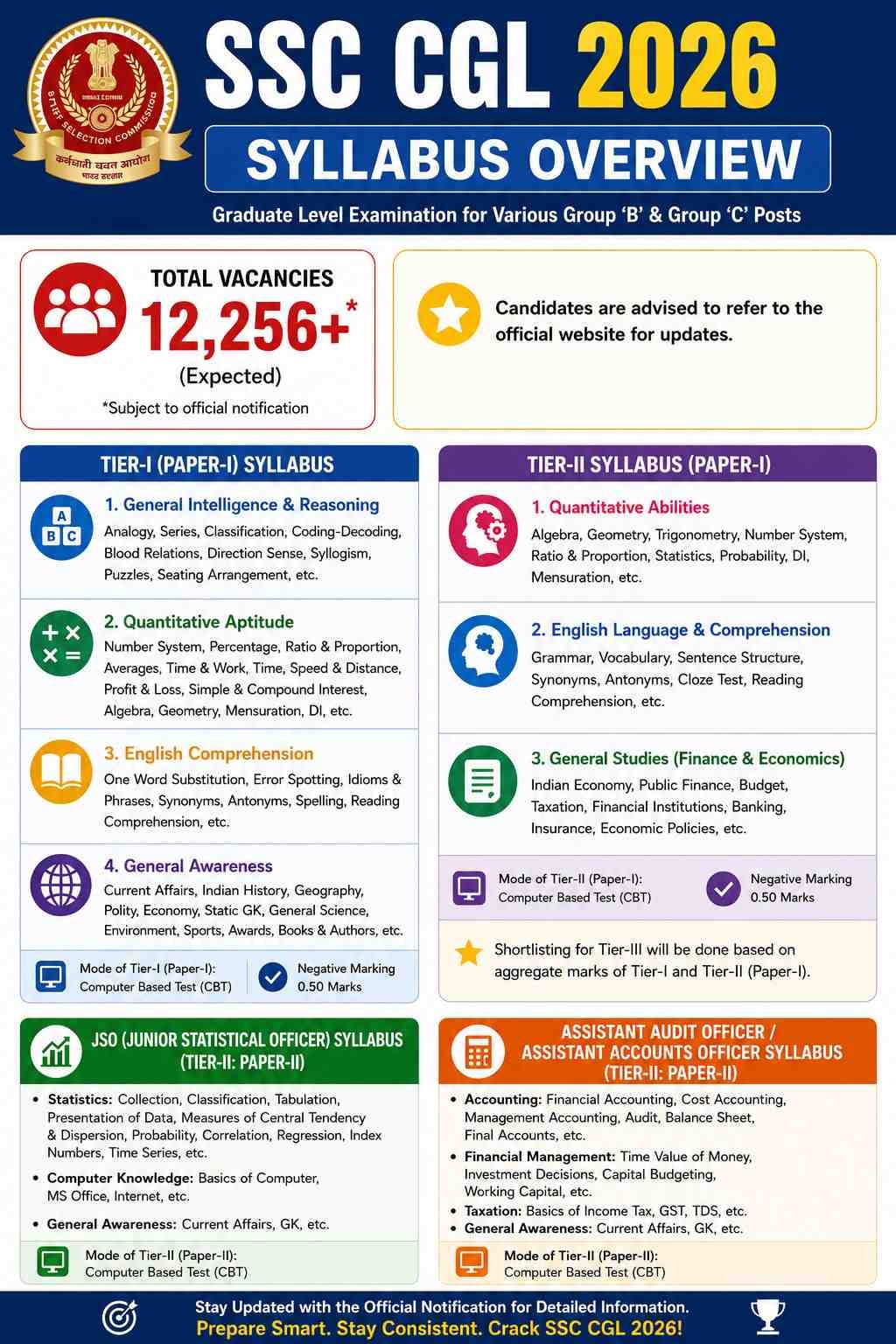
SSC has officially released the SSC CGL 2026 syllabus & notification on 21 May 2026. In this recruitment, around 12,256 vacancies have been announced for different Group B and Group C posts in various ministries, departments, and government offices across India. These include popular posts like Income Tax Inspector, Assistant Section Officer, Auditor, Accountant, Tax Assistant, Junior Statistical Officer, and many others. These jobs are highly preferred because they offer job security, good salary, and long-term career growth.
The notification clearly explains all the important details such as eligibility criteria, age limit, application dates, selection process, and exam pattern. According to it, candidates must have a graduation degree from a recognized university to apply for SSC CGL 2026. The age limit is generally between 18 to 32 years, but it can vary depending on the post. Candidates belonging to reserved categories also get age relaxation as per government rules.
Along with the notification, the complete SSC CGL 2026 syllabus has also been released, which helps students understand exactly what they need to study. This makes preparation much easier because now everything is officially clear. Overall, this is a great opportunity for graduates who want to build a stable career in the government sector, and now students can start their preparation with a proper direction.
SSC CGL 2026 Syllabus
The detailed syllabus of SSC Tier 1 and Tier 2 with marks is given below
Tier-I (Paper-I) – Screening Exam
Total Marks: 200 | Time: 60 Minutes | Negative Marking: 0.50
| Section | Syllabus | Marks |
|---|---|---|
| General Intelligence & Reasoning | Analogies, similarities & differences, coding-decoding, number & alphabet series, puzzles, blood relations, direction sense, order & ranking, syllogism, Venn diagrams, statement & conclusion, decision making, embedded figures, mirror & water images, paper folding/unfolding, figural classification, non-verbal series, critical thinking | 50 |
| General Awareness | Current affairs (national & international), history (ancient/medieval/modern), geography (India & world), Indian polity & constitution, economy basics, general science (physics, chemistry, biology), static GK (awards, books, sports), government schemes, important days, neighboring countries | 50 |
| Quantitative Aptitude | Number system, simplification, percentage, ratio & proportion, average, profit & loss, discount, simple & compound interest, time & work, time-speed-distance, mixture & allegation, algebra basics, geometry (triangles, circles, polygons), mensuration (2D & 3D), trigonometry basics, data interpretation, probability basics, statistics basics | 50 |
| English Comprehension | Reading comprehension, grammar rules, error spotting, sentence improvement, fill in the blanks, cloze test, synonyms & antonyms, idioms & phrases, one word substitution, active-passive voice, direct-indirect speech | 50 |
Tier-II (Paper-I) – Main Exam
Total Marks Main Exam: Approx 390+ | Time: 2 Hours 15 Min | Negative Marking: 1 Mark
| Section | Syllabus | Marks |
|---|---|---|
| Mathematical Abilities | Advanced number system, HCF & LCM, percentage applications, ratio & proportion (advanced), algebra (equations & identities), geometry (circle, triangle, polygons, tangents), mensuration (surface area & volume), trigonometry (identities & heights & distances), statistics (mean, median, mode, SD), data interpretation (advanced sets) | 90 |
| Reasoning & General Intelligence | Advanced coding-decoding, complex puzzles, seating arrangement, logical reasoning, syllogism, statement assumptions, embedded figures, analogy-based reasoning, classification, direction sense (advanced), analytical reasoning | 90 |
| English Language & Comprehension | Advanced grammar rules, sentence correction, error detection, vocabulary (synonyms/antonyms), idioms & phrases, one word substitution, reading comprehension (long passages), cloze test, sentence rearrangement | 135 |
| General Awareness | Advanced current affairs, Indian polity (articles, constitution), Indian economy (deep concepts), geography, history (detailed), science application-based questions, government policies, banking awareness basics | 75 |
| Computer Knowledge (Qualifying) | Computer fundamentals, MS Office (Word, Excel, PowerPoint), internet basics, email system, cyber security (virus, malware, phishing), networking (LAN/WAN), operating system basics, shortcut keys | 60 (Qualifying – not counted) |
| DEST (Typing Test) | Data Entry Speed Test (typing speed and accuracy) | Qualifying |
Tier-II Paper-II (Statistics)
Only for JSO (Junior Statistical Officer)–Total Marks: 200
| Syllabus | Topics |
|---|---|
| Data Collection, Classification & Presentation | Meaning of data, primary & secondary data, methods of data collection (census & sample survey), editing & coding of data, classification (qualitative, quantitative, chronological, geographical), tabulation, frequency distribution, diagrams & graphs (bar diagram, histogram, pie chart, frequency polygon) |
| Measures of Central Tendency | Arithmetic mean, median, mode, weighted mean, properties of mean/median/mode, partition values (quartiles, deciles, percentiles) |
| Measures of Dispersion | Range, quartile deviation, mean deviation, variance, standard deviation, coefficient of variation, relative measures of dispersion |
| Correlation & Regression | Meaning of correlation, types of correlation, Karl Pearson correlation, Spearman rank correlation, regression lines (X on Y, Y on X), scatter diagram, simple linear regression |
| Probability Theory | Basic probability concepts, classical/empirical/axiomatic probability, addition & multiplication rules, conditional probability, independent events, Bayes’ theorem |
| Sampling Methods | Population & sample, parameter & statistic, sampling errors, simple random sampling, stratified sampling, systematic sampling, cluster sampling, multistage sampling, non-probability sampling methods |
| Statistical Inference | Estimation (point & interval), properties of good estimator, hypothesis testing, Z-test, t-test, Chi-square test, F-test, confidence intervals, Type I & II errors |
| Time Series Analysis | Meaning of time series, components (trend, seasonal, cyclical, irregular), measurement of trend (moving average, least squares), seasonal variations |
| Index Numbers | Meaning, types, construction methods, Laspeyres index, Paasche index, Fisher index, base shifting, splicing, cost of living index, uses & limitations |
| Probability Distributions | Random variable (discrete & continuous), probability distribution function, mean & variance, binomial distribution, Poisson distribution, normal distribution, exponential distribution, basic joint distribution |
SSC CGL Tier-II (Paper-III – Finance & Economics)–Only for Assistant Audit
Officer/Assistant Accounts Officer–Total Marks: 200
| Section | Topics | Marks |
|---|---|---|
| Part A: Finance & Accounts | Fundamental principles of accounting, nature & scope of financial accounting, limitations of accounting, basic accounting concepts (entity, going concern, cost concept, matching concept, etc.), GAAP | 80 Marks |
| Single & Double Entry System | ||
| Books of Original Entry (Journal), Ledger posting & balancing | ||
| Trial Balance preparation & errors detection | ||
| Bank Reconciliation Statement (BRS) | ||
| Rectification of Errors (types, suspense account) | ||
| Final Accounts: Trading A/c, Profit & Loss A/c, Balance Sheet | ||
| Capital vs Revenue Expenditure | ||
| Depreciation Accounting (methods like SLM, WDV) | ||
| Valuation of Inventories (FIFO, LIFO, weighted average) | ||
| Non-Profit Organisation Accounts | ||
| Receipts & Payments Account | ||
| Income & Expenditure Account | ||
| Bills of Exchange | ||
| Self-Balancing Ledgers | ||
| Part B: Economics & Governance | CAG of India: constitutional provisions, role & responsibilities | 120 Marks |
| Finance Commission: role & functions | ||
| Basic Economics: definition, scope, nature, methods, central problems of economy, PPC | ||
| Demand: meaning, determinants, law of demand | ||
| Elasticity of Demand: price, income, cross elasticity | ||
| Consumer Behaviour: Marshallian utility approach & Indifference Curve approach | ||
| Supply: meaning, determinants, law of supply | ||
| Elasticity of Supply | ||
| Theory of Production: factors of production, law of variable proportions, returns to scale | ||
| Market Structures: Perfect Competition, Monopoly, Monopolistic Competition, Oligopoly | ||
| Indian Economy: agriculture, industry, services (growth & problems) | ||
| National Income: concepts (GDP, GNP, NNP) & methods of measurement | ||
| Population: size, growth rate, impact on economy | ||
| Poverty & Unemployment: types, causes, incidence | ||
| Infrastructure: energy, transport, communication | ||
| Economic Reforms (1991): liberalisation, privatisation, globalisation, disinvestment | ||
| Money & Banking: RBI, commercial banks, RRBs, payment banks | ||
| Monetary & Fiscal Policy | ||
| Budget, Fiscal Deficit, Balance of Payments | ||
| FRBM Act, 2003 | ||
| IT in Governance |