After India became independent in 1947, the country needed proper planning for development. So, under the leadership of India’s first Prime Minister, an Economic Planning Committee was formed. Based on the suggestions of this committee, the Planning Commission of India was set up on 15 March 1950 to make plans for the country’s growth and development.
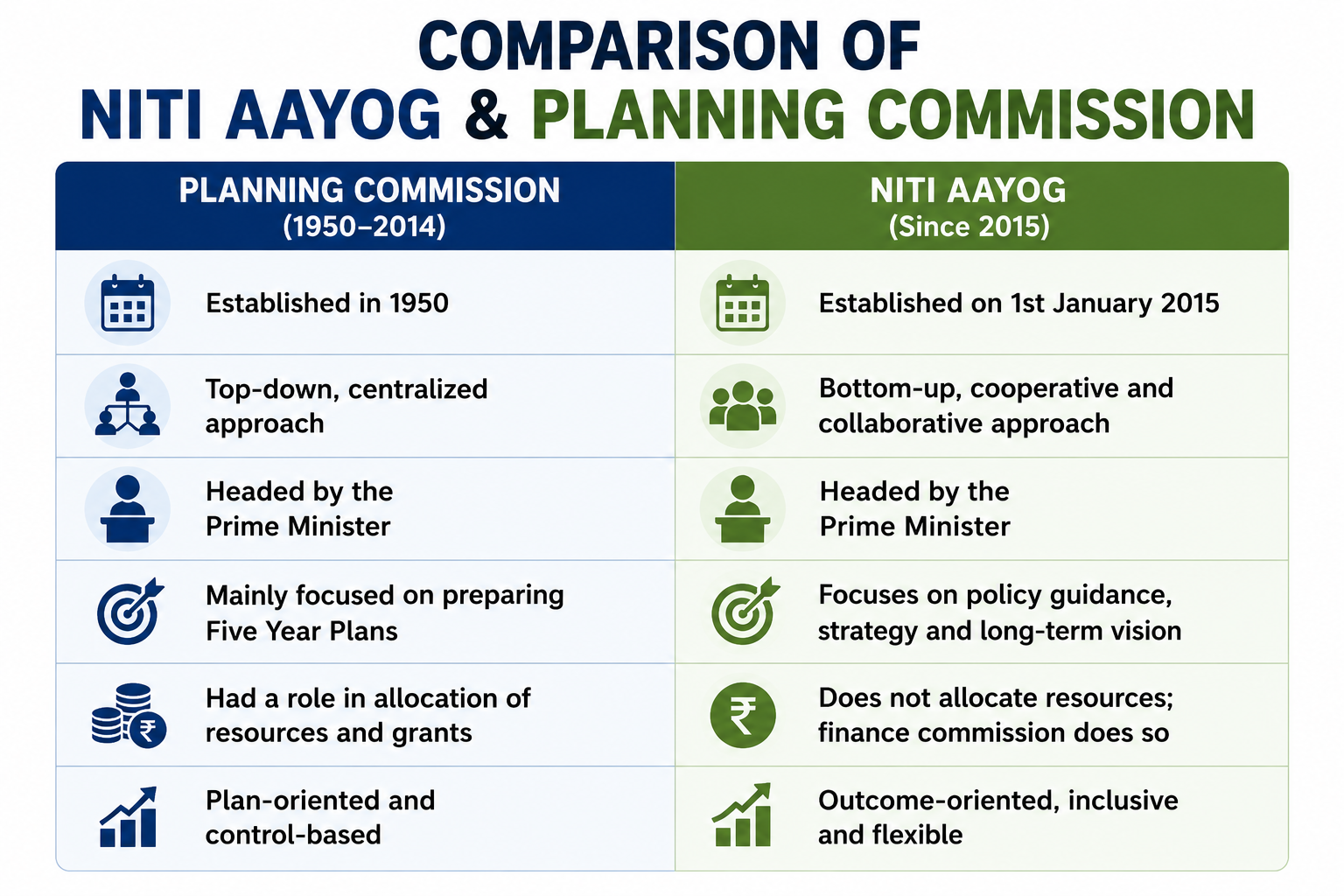
Its main job was to prepare five-year plans for the economic development of the country. In the early years, the Planning Commission played an important role in building the Indian economy because India had just become independent and needed proper planning for development. Planning Commission was neither a Constitutional Body nor a Statutory Body It was only an advisory body created by an Executive Resolution of the Government of India. The Prime Minister of India was the Chairman of the Planning Commission.
Planning commission
The Planning Commission was created to make proper plans for the development of the country. Its main aim was to use the country’s resources and manpower in the best way so that India could grow economically.
It also focused on increasing production, creating more employment opportunities, reducing poverty, and improving the lifestyle of common people. Another important goal was to make sure every region and state of the country develops equally. Along with this, the Planning Commission worked on improving agriculture and industries so that the economy of the country could become stronger
But as time passed, many changes took place in the economy and the needs of different states also became different. States & People started criticizing the Planning Commission for being too centralized, because most decisions were taken in Delhi and states did not get much importance. It was also considered rigid and old-culture in its working style.
Because of these reasons, the Central Government abolished the Planning Commission on August 2014. After that, on 1 January 2015, a new institution called NITI Aayog was established as its replacement.
NITI Aayog
The full form of NITI Aayog is National Institution for Transforming India. Like the Planning Commission, NITI Aayog was also created through an Executive Resolution of the Government of India. Therefore, it is neither a Constitutional Body nor a Statutory Body. It is a policy think tank that helps the government by giving new ideas, strategies, and development plans for the country.
Earlier, planning commission used to be done mostly in a top-down manner by the Planning Commission, where decisions & polycies were made in Delhi and then passed on to the states. States didn’t really have much say in it.
But NITI Aayog changed this style. Now the focus is more on what is happening at the ground level. First, the needs of villages, districts, and states are understood, and then policies are designed based on that. So instead of just pushing decisions from the top, ideas also come from the bottom.
Because of this, states are now more involved in system. They can share their problems, priorities, and suggestions openly, and those inputs are taken seriously while making national policies.
Simply , it is more like teamwork now. The Centre and States sit together, discuss issues, and try to find solutions that work for everyone. This approach is known as cooperative federalism, where everyone contributes to the development of the country instead of working in isolation.
Function of NITI Aayog
NITI Aayog works in a very simple way to support the development of the country. Its main functions are
Policy and Planning Support
It helps the central and state governments in making better policies and development plans. It gives suggestions on how schemes in areas like education, health, agriculture, and jobs can be improved.
Promoting Cooperative and Competitive Federalism
It encourages the Centre and States to work together like a team. At the same time, it also motivates states to improve their performance by learning from each other and doing better than others in development work. in Cooperative Federalism Subgroups of Chief Ministers, MGNREGS and Agriculture, Centrally Sponsored Schemes, Skill Development, Swachh Bharat ect & Competitive Federalism Aspirational Districts Program /Aspirational Block Program, State Rankings & SDGs
Monitoring and Evaluation
NITI Aayog keeps an eye on government schemes and programs. It check whether they are working properly or not, and if something is not working well, it suggests improvements
Think Tank and Innovation Hub
It works like an idea center for the government. It brings new ideas, research, and innovative solutions to solve India’s development challenges and improve governance.